
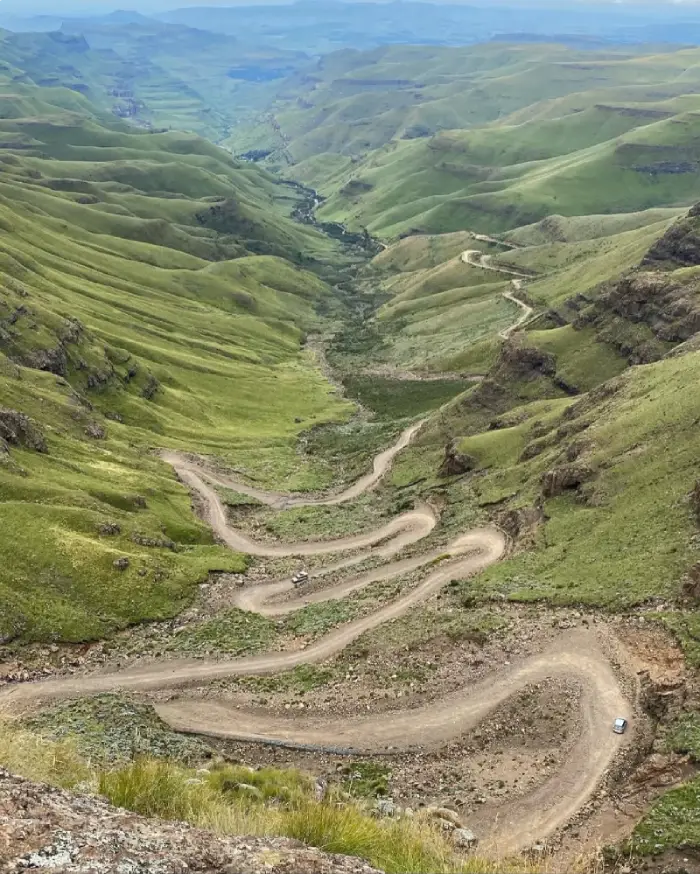
Discover the Kingdom in the Sky one road at a time
Driving in Lesotho can be one of the most rewarding ways to explore the country.
Leave Maseru and the landscape can change quickly. Buildings become fewer, mountains become larger, villages appear against enormous valleys, and horses and livestock become part of the scenery.
But Lesotho is mountain country.
That means driving here deserves preparation and respect. For official visitor information and road-safety advice, consult the Lesotho Tourism Development Corporation’s travel guide.
Road conditions can change with weather, construction and season. A route that was straightforward for one traveller in dry conditions may be very different during heavy rain, fog, snow or freezing weather.
Plan for the road you are driving today—not the road somebody drove last year.
Before a long or remote journey, check current weather, road conditions, vehicle suitability, fuel availability and local travel information.
What Should Tourists Know About Driving in Lesotho?
The most important basics are straightforward:
- Drive on the left
- Wear your seatbelt
- Follow posted speed limits and road signs
- Allow more time than distance alone suggests
- Watch for pedestrians, livestock and horse riders
- Prefer daylight travel where practical
- Download offline maps
- Refuel before remote journeys
- Check mountain weather
- Choose a vehicle suitable for your route
- Confirm rental restrictions before travelling
- Get the required written permission before taking a rental vehicle across an international border
And remember:
Never assume that “only 100 km” means a quick drive in Lesotho.
Is Driving in Lesotho Easy?
That depends entirely on where you are going.
Driving around Maseru is very different from driving deep into remote mountain country.
Instead of asking only, “Is driving in Lesotho easy?”, ask:
- Which road?
- Which season?
- Which vehicle?
- Which weather conditions?
- Which destination?
For practical planning, think of Lesotho driving in three broad categories.
Maseru and Urban Driving
This is generally the easiest introduction for visitors.
Expect city traffic, pedestrians, taxis, intersections, shops, businesses, residential areas and paved roads.
Drive patiently and remain alert.
Major Intercity and Tourism Routes
These can include paved highways and improved roads connecting major towns, tourism destinations, dams and regional centres.
Even on better roads, you may encounter:
- Mountain gradients
- Sharp curves
- Pedestrians
- Livestock
- Slow vehicles
- Changing weather
- Road works
- Surface damage
A paved road is not automatically an easy road.
Remote Highland and Rural Routes
This is where vehicle choice and preparation become particularly important.
Depending on the route and current conditions, you may encounter:
- Gravel
- Rock
- Mud
- Snow or ice
- Steep gradients
- Narrow roads
- Poor surfaces
- Water crossings
- Remote stretches
- Limited mobile coverage
Never plan a remote highland journey as though you were simply driving across Maseru.
Which Side of the Road Does Lesotho Drive On?
Lesotho drives on the left-hand side.
For South African visitors, this is familiar.
Travellers accustomed to driving on the right should take extra care, particularly when:
- Leaving petrol stations
- Exiting parking areas
- Turning at intersections
- Entering quiet roads
- Using roundabouts
The moment to be especially careful is often after you have relaxed and begun driving automatically.
Pause before pulling away and remind yourself:
Keep left.
Roundabouts and Intersections
Foreign drivers should take extra care at roundabouts, junctions, turns, parking exits and intersections.
Follow road signs and observe surrounding traffic rather than assuming right of way.
When uncertain, slow down.
Road Conditions in Lesotho
There is no single description that fits every road in Lesotho.
Some major routes are paved.
Others are gravel.
Some remote routes can become significantly more difficult because of rain, snow, ice, mud or deteriorating surfaces.
The useful question is therefore not:
“What are Lesotho's roads like?”
It is:
“What is the specific road to my destination like today?”
Paved Main Roads
Many towns and popular destinations are connected by paved roads.
For some conventional tourism itineraries, a normal passenger vehicle may be suitable.
But paved does not mean hazard-free.
You may still encounter potholes, sharp bends, steep gradients, pedestrians, livestock, taxis, slow vehicles, poor visibility, road works or weather damage.
Drive according to conditions.
Gravel and Unpaved Roads
Away from major routes, unpaved roads become more common.
Conditions can range from relatively manageable gravel to rough mountain tracks.
That distinction matters.
A journey might be easy for most of its distance but finish with a difficult access road.
That final section can determine which vehicle you actually need.
Before leaving, ask:
“What is the last section of the journey like?”
Mountain Roads
This is where Lesotho becomes spectacular—and where driving can demand more attention.
Mountain routes may involve:
- Steep ascents
- Long descents
- Tight bends
- Limited visibility
- Narrow sections
- Changing surfaces
- Fog
- Snow
- Ice
- Strong winds
Never rush simply because your navigation app says you are almost there.
The final kilometres can sometimes be the slowest.
Distance Is Not Driving Time
This is one of the most important lessons for a Lesotho road trip.
100 km through mountain country is not the same as 100 km on a motorway.
Your journey may slow because of:
- Mountain passes
- Villages
- Animals
- Weather
- Road works
- Gravel
- Scenic stops
- Changing road conditions
Build buffer time into your itinerary.
Instead of asking only, “How far is it?”, also ask:
“What is the road like, and how long should I realistically allow?”
Do You Need a 4x4 in Lesotho?
Not everywhere.
One common misconception is that you need a 4x4 to travel anywhere in Lesotho.
You don't.
A conventional passenger vehicle may be suitable for Maseru, many major roads, town-to-town travel and accessible attractions, depending on current conditions.
But some routes demand more capable vehicles.
When a Normal Car May Be Suitable
A conventional vehicle may suit:
- Maseru
- Major paved roads
- Town-to-town journeys
- Accessible attractions
- Normal urban business travel
Always check your specific route before departure.
When Higher Ground Clearance May Help
Higher clearance can be useful on:
- Rough gravel
- Rural access roads
- Poor road surfaces
- Remote accommodation access roads
- Some mountain routes
- Roads affected by wet conditions
Ground clearance can matter even where four-wheel drive itself is not necessary.
When a 4x4 May Be Appropriate
A 4x4 may become useful or necessary for certain:
- Remote highland routes
- Rough mountain tracks
- Muddy roads
- Difficult gravel
- Technical access roads
- Snow-affected routes
- Roads specifically requiring four-wheel drive
Do not choose a 4x4 because it looks adventurous.
Choose it because it fits the route and current conditions.
Sani Pass Is a Special Case
Sani Pass should not be treated like an ordinary paved road.
It is a mountain border route where road conditions, weather, vehicle requirements and border arrangements matter.
If your itinerary includes Sani Pass, verify current:
- Vehicle requirements
- Road conditions
- Weather
- Border operating arrangements
- Rental restrictions
Do this before departure.
Renting a Car for Lesotho
A rental vehicle can give visitors excellent flexibility.
You can choose your departure time, stop for scenery and build an itinerary around your own interests.
But not all rental agreements are equal.
Choose the Route Before Choosing the Vehicle
Do not begin with:
“What is the cheapest rental car?”
Begin with:
“Where am I actually going?”
Someone travelling mainly around Maseru and accessible main-road destinations has different requirements from someone planning remote highland tracks.
Choose the itinerary first.
Then choose the vehicle.
Rental-Car Checklist
Before signing, confirm:
- Lesotho travel is permitted
- Cross-border permission is available if renting in South Africa
- Required authorisation is supplied in writing
- Insurance applies in Lesotho
- Tyres are appropriate and in good condition
- A usable spare wheel is present
- Required tools are present
- Emergency or roadside support is available
- Gravel-road restrictions
- Off-road or 4x4 restrictions
- Mileage policy
- Fuel policy
Bringing a South African Rental Car Into Lesotho
Do not assume a South African rental vehicle may automatically enter Lesotho.
Ask the rental company directly whether the specific vehicle may travel into Lesotho and what documentation is required.
Get any required permission in writing before departure.
Driving From South Africa to Lesotho
Many Lesotho road trips begin in South Africa, particularly from Gauteng, Free State or KwaZulu-Natal.
Your exact route will depend on where you are entering Lesotho and where you are going afterward.
Border posts, visas, passports, immigration requirements and border operating hours are separate cross-border issues and should be checked using current official information.
Once you have entered Lesotho, the focus changes to the road ahead.
Johannesburg to Maseru
Johannesburg is a common starting point for international visitors, business travellers and road trippers.
Do not build the journey around one guaranteed driving time.
Traffic, stops, weather, border conditions and road conditions can all affect the trip.
Treat it as a proper intercity journey rather than a quick transfer.
Bloemfontein to Maseru
Bloemfontein provides a closer South African starting point for some travellers heading toward Maseru.
Remember to plan for both road travel and the international border crossing.
Durban to Lesotho
Travellers coming from KwaZulu-Natal may use very different routes depending on their final destination.
A highlands itinerary can look completely different from a journey directly to Maseru.
Destination determines route.
Driving Around Maseru
Maseru provides a manageable introduction to driving in Lesotho for many visitors.
Expect:
- City traffic
- Taxis
- Pedestrians
- Shops
- Businesses
- Intersections
- Residential areas
Drive patiently.
Most importantly, remember that Maseru is not the highlands.
Feeling comfortable driving around the capital does not mean a remote mountain route will offer the same conditions.
As the environment changes, your driving style and preparation should change too.
Starting Your Road Trip From Lion Guard Guest House
Lion Guard Guest House is in Ha-Matala, Maseru, making it a practical starting point for Maseru activities, business appointments and selected excursions beyond the city.
Before a longer journey, use your accommodation as a preparation point.
Check:
- Fuel
- Weather
- Route
- Phone battery
- Water
- Vehicle condition
- Expected arrival time
Then leave prepared.
Scenic Road Trips From Maseru
Maseru can be a useful starting point for several different types of road trips.
Some are suitable for shorter excursions.
Others deserve considerably more time.
Maseru to Thaba Bosiu
Thaba Bosiu is one of Lesotho's most important historical areas and is closely associated with King Moshoeshoe I and the formation of the Basotho nation.
For first-time visitors, the journey can combine mountain scenery with cultural and historical context without immediately committing to a deep-highlands expedition.
Check current visitor arrangements before travelling.
Maseru to Morija
Morija offers history, culture and heritage.
It can be particularly appealing to families, history lovers, cultural travellers and educational visitors.
If you intend to visit specific museums or heritage attractions, confirm their current opening arrangements before departure.
Maseru to Semonkong and Maletsunyane Falls
This is a more substantial excursion.
Semonkong and Maletsunyane Falls deserve proper time rather than being treated as a quick trip outside the city.
Before leaving, check:
- Weather
- Road conditions
- Fuel
- Departure time
- Current attraction arrangements
- Your return plan
If your itinerary feels rushed, consider whether an overnight stay would create a better trip.
Maseru Toward Mohale
A journey toward Mohale can reveal the scale of Lesotho's mountain landscapes and water infrastructure.
This is the kind of trip where the journey itself becomes part of the attraction.
Allow time for the road and scenery.
Maseru to Katse
Katse is one of Lesotho's major highland destinations.
Do not treat it as a casual short drive from Maseru.
Plan for:
- Realistic travel time
- Fuel
- Weather
- Current road conditions
- Accommodation if appropriate
- Current visitor arrangements
Sometimes the best road-trip decision is to stay overnight instead of forcing a long return journey into one day.
Northern Lesotho
Northern Lesotho opens routes toward places such as Hlotse/Leribe, Butha-Buthe and Ts'ehlanyane.
Different routes require different levels of preparation.
Ts'ehlanyane National Park, for example, should be treated as a northern destination rather than something just outside Maseru.
Plan substantial excursions realistically.
Prefer Daylight Driving Where Practical
For visitors unfamiliar with Lesotho's roads, daylight is your friend.
It gives you better visibility, easier navigation and more time to respond to pedestrians, livestock, road damage and changing conditions.
Night driving can involve:
- Limited street lighting
- Animals on roads
- Pedestrians
- Reduced visibility
- Unmarked hazards
- Additional security considerations
Where practical, plan unfamiliar or remote journeys during daylight.
Livestock on the Road
Roads in Lesotho may be shared with animals.
Drivers can encounter:
- Cattle
- Sheep
- Goats
- Horses
- Donkeys
Slow down and give animals space.
Never assume an animal will behave predictably.
Basotho Horse Riders
Horses remain part of transport and rural life in Lesotho.
When approaching horse riders, slow down, give them adequate space and pass carefully.
You are sharing the road.
Pedestrians
People may walk alongside roads between communities.
Expect pedestrians even in places where visitors from other countries might not anticipate them.
Take particular care around villages, schools and towns and when visibility is poor.
Minibus Taxis and Other Vehicles
Local transport is part of everyday road life.
Drive defensively and patiently.
Do not compete aggressively for road space.
Weather Can Change the Road
Lesotho's elevation contributes to its spectacular scenery, but it also makes weather an important driving consideration.
Conditions can include:
- Heavy rain
- Thunderstorms
- Fog
- Strong winds
- Snow
- Ice
- Freezing temperatures
The higher and more remote your journey, the more important it becomes to check current conditions.
Winter Driving in Lesotho
Winter can produce beautiful mountain scenery, but higher-altitude driving can become demanding.
Snow and ice can affect traction, visibility, road access and travel time.
Before heading into mountain areas, check current conditions and make sure your vehicle and plans are appropriate.
Don't Chase Snow Without a Plan
Snow photographs can make travellers want to head immediately into the mountains.
Before doing that, ask:
- Is the road currently open?
- Is my vehicle suitable?
- Do I have adequate warm clothing?
- Do I have enough fuel?
- What happens if conditions worsen?
- Can I safely return?
Snow is both scenery and weather.
Treat it as both.
Summer Driving
Summer can bring green landscapes and dramatic scenery.
Rain and thunderstorms can also affect roads.
On unpaved routes in particular, wet weather can change conditions quickly.
Driving in Fog
Fog can dramatically reduce visibility.
If conditions deteriorate:
- Slow down
- Use appropriate vehicle lighting
- Increase following distance
- Avoid rushing because you are behind schedule
Your itinerary is less important than arriving safely.
Fuel: Fill Up Before Remote Journeys
Fuel is generally easier to obtain around Maseru and larger towns than on remote journeys.
Do not build a highlands trip around the assumption that another petrol station will appear exactly when you need one.
Refuel before long or remote routes and understand your vehicle's range.
Check the Vehicle Before Leaving
Before a substantial road trip, check:
- Fuel
- Tyres
- Spare wheel
- Jack and tools
- Lights
- Windscreen
- Wipers
- Essential fluids
- Phone charge
- Navigation
- Emergency contacts
Preparation is part of the journey.
Tyres Matter
A vehicle can have every comfort feature imaginable, but those features will not help much if its tyres are unsuitable or in poor condition.
Check:
- Tyre condition
- Pressure
- Spare wheel
- Suitability for your intended route
For difficult roads, vehicle suitability matters more than appearance.
Carry Water and Basic Snacks
Remote journeys can take longer than expected.
A breakdown, weather delay or route change can turn an ordinary trip into a long wait.
Carry water.
For longer routes, basic snacks are sensible too, particularly when travelling with children.
Do not assume shops and restaurants will appear at perfectly convenient intervals.
Download Offline Maps
Before leaving Maseru or another major town, download offline maps.
Save:
- Your destination
- Accommodation
- Important towns
- Fuel stops
- Return route
- Emergency contacts
Mobile coverage can become less reliable in remote mountain areas.
Navigation Apps Are Tools, Not Guarantees
Digital navigation can tell you that a road exists.
It cannot always tell you what that road is like today.
If a suggested route appears unusually remote, technical or unfamiliar, seek current local information before committing to it.
One of the most useful questions you can ask is:
“What is the road like today?”
Current local knowledge can be far more useful than an old travel forum.
Keep Your Phone Charged
Navigation, photography and poor signal can all consume battery power.
Carry a car charger.
For longer or remote journeys, a power bank is useful too.
Vehicle Security
Use sensible security precautions.
Where appropriate:
- Keep doors secured
- Keep valuables out of sight
- Avoid leaving phones, cameras, bags or wallets visibly unattended
- Use secure parking where available
- Remain aware of your surroundings when stopping
No destination should be given a blanket safety guarantee.
Current road and travel advice should always take priority over old travel information.
Stopping for Strangers
Exercise judgment when people attempt to flag down your vehicle.
Prioritise your safety and avoid giving lifts to unknown people when doing so would place you at unnecessary risk.
If a situation appears suspicious, continue to a safer location where practical.
Don't Drive Tired
Fatigue can be as dangerous as difficult road conditions.
If you have already flown, collected a rental car, driven for several hours, crossed an international border and reached Maseru, consider whether continuing immediately into the mountains is sensible.
Sometimes the better decision is simple:
Sleep first. Drive tomorrow.
Maseru as a Road-Trip Base
Maseru can function as a useful preparation base.
Use the city to:
- Rest
- Refuel
- Buy supplies
- Check weather
- Download maps
- Plan routes
- Handle business
- Begin shorter excursions
Then head into the mountains prepared.
Why Lion Guard Guest House Works for Road Travellers
For guests travelling by car, practical accommodation features can matter as much as location.
At Lion Guard Guest House, amenities include:
- Secure enclosed parking
- Free Wi-Fi
- Private bathrooms
- Reliable hot water
- In-room fridge
- Table and chair
- Heater during colder weather
- Electric blanket
- Daily housekeeping
Before the road, you can rest, check weather, charge devices, use Wi-Fi and prepare your route.
After the road, you can park, shower, rest, charge your phone and prepare for tomorrow.
Lion Guard Travel Tip
Don't try to see the whole country in two days.
Lesotho may look small on a map, but mountains change travel time. Choose fewer destinations, spend more time experiencing them and leave room for the unexpected.
Lesotho rewards slower travel.
Road Trips for Couples
A road trip gives couples flexibility to stop for photographs, enjoy views, visit cultural attractions and explore at their own pace.
The mistake is trying to fit too much into one day.
Leave space in the itinerary to enjoy the journey.
Road Trips for Families
Families benefit from flexible schedules, but preparation becomes even more important.
Consider carrying:
- Water
- Snacks
- Warm clothing
- Child essentials
- Entertainment
- Required medication
- Extra time for stops
With children, buffer time makes the journey easier.
Road Trips for Business Travellers
Business travel depends on predictability.
If you have an important meeting, avoid scheduling a remote mountain journey immediately beforehand.
Use Maseru as your business base, build extra time into road journeys and avoid creating an itinerary where one delay affects your professional commitments.
International Visitors
If you are unfamiliar with left-hand driving, mountain roads or Southern African road conditions, begin gently.
Become comfortable with your vehicle around Maseru or another manageable area before increasing the complexity of your itinerary.
Confidence should come from familiarity and preparation—not from rushing.
Adventure Travellers
Adventure does not mean ignoring preparation.
For remote road travel, think about:
- Vehicle suitability
- Fuel
- Weather
- Navigation
- Water
- Food
- Communication
- Recovery options
- Accommodation
- Daylight
The better prepared you are, the more confidently you can explore.
Road Trips for Photographers
Lesotho offers extraordinary landscapes for photographers.
But never stop in a dangerous place just because the view is beautiful.
Use safe, legal stopping areas.
Do not block traffic or stop blindly around mountain bends.
When you see the perfect view, ask:
“Where can I stop safely?”
The mountain will still be there.
What to Pack in the Car
A practical road-trip kit can include:
- Water
- Snacks
- Warm layer
- Waterproof jacket
- Sunscreen
- Sunglasses
- Hat
- Phone charger
- Power bank
- Offline maps
- Basic first-aid kit
- Required medication
- Vehicle documents
- Driver's licence
- Accommodation details
- Emergency contacts
- Torch
Expand your kit according to the route, weather and remoteness of the journey.
What to Check the Night Before
Before a significant journey, check:
- Weather
- Route
- Current road conditions
- Fuel
- Vehicle condition
- Destination opening arrangements
- Accommodation
- Expected daylight
- Phone battery
- Offline maps
Then get enough rest.
Before Leaving Maseru
Ask yourself:
Do we have enough fuel?
Do we know the route?
Have we checked current conditions?
Is the vehicle suitable?
Do we have water?
Is our planned arrival time realistic?
If one answer is no, solve it before leaving.
If Weather Deteriorates
Do not let “but we already booked” become a reason to drive into conditions that are unsafe for your vehicle, experience or route.
Travel plans can change.
Safety comes first.
If You Get a Flat Tyre
Before travelling remotely, know where your spare wheel and jack are and make sure the spare is usable.
Finding out that your spare tyre has no air when you are already stranded is too late.
If You Break Down
Where possible, move to a safe location and make the vehicle visible appropriately.
Depending on the situation, contact your:
- Rental company
- Roadside-assistance provider
- Accommodation
- Police
- Appropriate emergency service
Remote areas may have fewer support options.
That is another reason preparation matters.
If You Get Lost
Do not continue blindly because you assume the road must eventually lead somewhere useful.
Stop somewhere safe.
Check your offline navigation.
Return to the last known route if appropriate.
Seek information from a reliable local source.
15 Common Driving Mistakes in Lesotho
1. Assuming Every Road Is Paved
It isn't.
2. Assuming Every Paved Road Is Easy
Mountains and weather still matter.
3. Choosing the Vehicle Before the Route
Reverse the process.
4. Trying to Cover Too Much in One Day
Mountain travel takes time.
5. Planning Remote Roads After Dark
Prefer daylight where practical.
6. Ignoring Weather
Altitude can change conditions quickly.
7. Waiting Too Long to Refuel
Fill up before remote journeys.
8. Relying Entirely on Mobile Data
Download offline maps.
9. Ignoring Livestock
Expect animals on some roads.
10. Driving Too Quickly Through Communities
Roads are shared with pedestrians and local traffic.
11. Treating a Navigation ETA as a Promise
It isn't.
12. Taking an Unsuitable Rental Vehicle
Check your route and agreement.
13. Forgetting Cross-Border Rental Permission
Get required authorisation before departure.
14. Leaving Valuables Visible
Keep them secured and out of sight.
15. Turning the Holiday Into a Race
Slow down.
Frequently Asked Questions
Is Driving in Lesotho Safe for Tourists?
Many visitors explore Lesotho by road, but sensible precautions are necessary.
Road conditions vary, mountain routes can be challenging, livestock and pedestrians may be present, and unfamiliar night journeys can introduce additional hazards.
Check current travel information and drive according to conditions.
Which Side of the Road Does Lesotho Drive On?
Lesotho drives on the left-hand side.
Do I Need a 4x4 in Lesotho?
Not for every journey.
Many urban and major-road itineraries may be suitable for conventional vehicles, depending on current conditions.
Remote routes, rough roads and severe weather can require greater ground clearance or four-wheel-drive capability.
Check your exact route.
Do I Need a 4x4 for Sani Pass?
Sani Pass has specific route and vehicle considerations and should be treated separately from ordinary road travel.
Check current requirements, road conditions and weather before attempting the route.
Can I Rent a Car to Explore Lesotho?
Yes, but check the rental agreement, insurance, road restrictions, vehicle suitability and cross-border permission where applicable.
Can I Bring a South African Rental Car Into Lesotho?
Some rental companies permit their vehicles to enter Lesotho, subject to their terms and required documentation.
Confirm permission directly with the rental company and obtain any required written authorisation before departure.
Can Tourists Use Foreign Driving Licences in Lesotho?
The requirements can depend on the licence and the traveller's circumstances.
International visitors should verify the current rule that applies to their specific licence before driving.
Are Lesotho's Roads Paved?
Some major roads are paved, while many rural and interior roads are unpaved.
Conditions vary significantly according to route, weather and maintenance.
Is Night Driving Recommended?
Daylight is generally the better default for visitors travelling unfamiliar or remote routes.
Night travel can involve reduced visibility, limited lighting, pedestrians, livestock and other hazards.
Are There Animals on Lesotho Roads?
Yes.
Drivers may encounter cattle, sheep, goats, horses and donkeys, particularly outside urban areas.
Slow down and give animals space.
Are Petrol Stations Easy to Find?
Fuel is easier to obtain around major towns.
For remote highland journeys, refuel early and plan your range.
Can I Rely on Google Maps?
Digital navigation is useful, but download offline maps as well.
For remote routes, seek current information about road conditions rather than relying solely on navigation software.
Is Maseru a Good Base for Road Trips?
Maseru can work well for city activities, trip preparation, nearby cultural excursions and selected regional journeys.
Destinations deeper in the highlands may be better treated as overnight or multi-base trips.
Can I Drive From Maseru to Maletsunyane Falls and Back?
The route can form part of a road itinerary, but it should be treated as a substantial excursion rather than a quick trip outside Maseru.
Check current road conditions, daylight and realistic travel time before departure.
Can I Drive From Maseru to Katse Dam?
It can form part of a Lesotho road trip depending on current conditions, but it is a significant mountain journey.
Consider your available time, weather, vehicle and whether an overnight stay would create a more comfortable itinerary.
What Should I Carry in the Car?
At minimum, consider water, a phone charger, offline maps, suitable clothing, important documents, required medication and basic emergency supplies.
Expand your preparation for remote routes.
What Should I Do Before a Winter Road Trip?
Check current weather, road conditions, vehicle suitability, fuel, warm clothing and your contingency plan.
What Is the Biggest Mistake First-Time Drivers Make?
Trying to cover too much too quickly.
Lesotho is best experienced one road, one valley and one mountain at a time.
Explore Lesotho One Road at a Time
Driving in Lesotho is not simply transportation.
The road becomes part of the experience.
One moment you are leaving Maseru.
Then the landscape opens.
The road climbs.
A village appears on the hillside.
A horse rider moves across the landscape.
Clouds pass over the mountains.
You stop somewhere safe, step out of the vehicle and realise that the journey was never only about getting from one place to another.
The destination matters.
But in Lesotho, so does everything between destinations.
Drive carefully.
Travel slowly.
Prepare properly.
Respect the road and the communities you travel through.
And give yourself enough time to look around.