
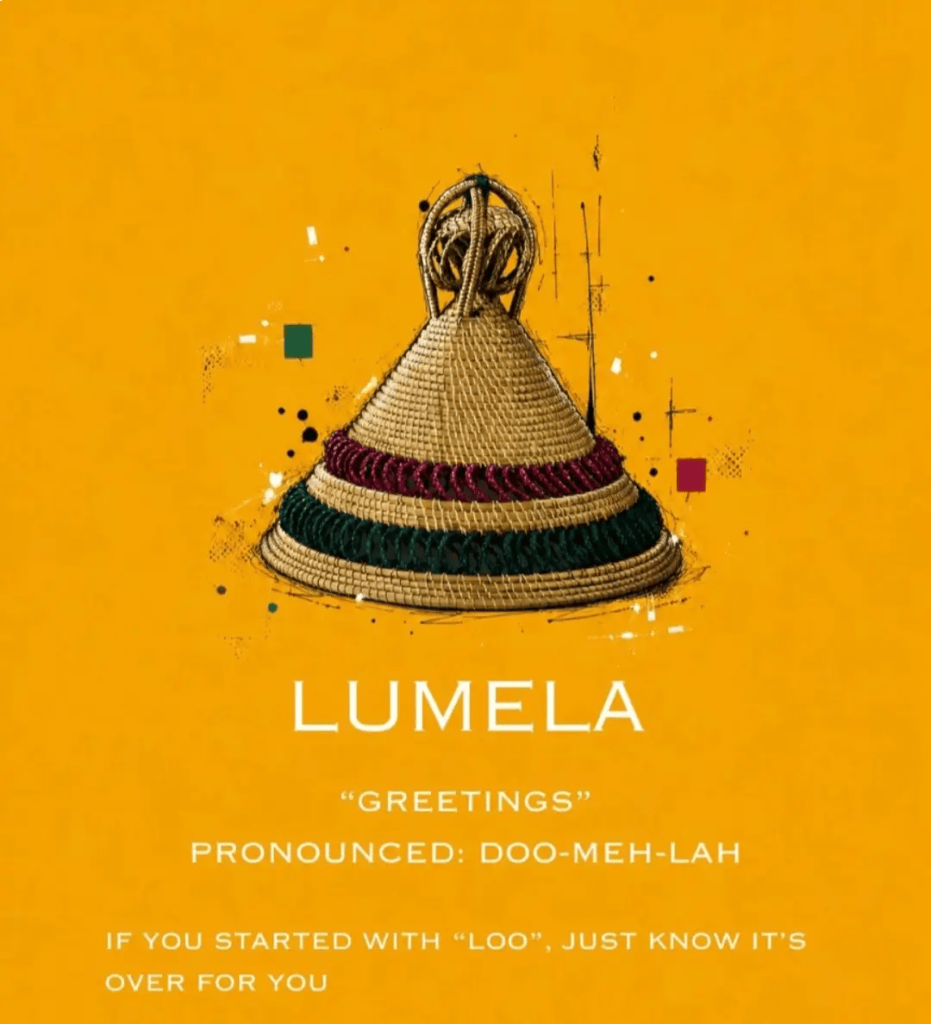
Learning these essential Sesotho phrases for visitors helps you greet people, ask simple questions and show appreciation during your Lesotho trip. You don’t need perfect Sesotho—just a willingness to try.
A visitor who says Lumela instead of immediately beginning in English has already done something important.
You have acknowledged the person before the transaction.
That is why learning a few essential Sesotho phrases before visiting Lesotho can make your trip friendlier, more respectful and more memorable.
You don't need fluency. You don't need perfect pronunciation. And you certainly don't need to memorise an entire dictionary.
Start with a few useful phrases, listen carefully and be willing to learn from the people you meet.
Essential Sesotho Phrases for Visitors: Five to Learn Before You Arrive
If you remember nothing else from this guide, start with these five:
1. Lumela
Hello
2. U phela joang?
How are you?
3. Kea leboha
Thank you
4. Ke kopa...
Please / I would like...
5. Ntšoarele
Excuse me / Sorry
Learn those five first.
Then start talking.
Quick Sesotho Language Guide
Country: Lesotho
People: Basotho
One person: Mosotho
Language: Sesotho
Official languages: Sesotho and English
Capital: Maseru
Hello: Lumela
Thank you: Kea leboha
Please / I would like: Ke kopa...
Excuse me / Sorry: Ntšoarele
I don't understand: Ha ke utloisise
Do you speak English?: U bua Senyesemane?
A useful travel principle is simple:
Try Sesotho first. Use English when necessary.
Why Learn Sesotho Before Visiting Lesotho?
You can photograph Lesotho's mountains.
You can drive its mountain roads.
You can stand beside its waterfalls and explore its historical places.
But some of the most memorable moments of a Lesotho journey happen when somebody talks to you.
It might be a shopkeeper, guide, waiter, driver or someone you meet while exploring Maseru.
Sometimes one word changes the entire interaction:
Lumela.
Hello.
Suddenly, you aren't simply looking at Lesotho.
You are interacting with it.
Learning even a few Sesotho phrases can help you greet people respectfully, ask simple questions, shop more confidently and show genuine interest in Basotho culture.
What Language Is Spoken in Lesotho?
Sesotho and English are the official languages of Lesotho.
Visitors will encounter English in many formal, business, educational, government and tourism settings.
Sesotho, however, remains central to everyday communication, identity, family, community, storytelling and Basotho culture.
Learning some basic Sesotho isn't simply about solving a communication problem.
It is also a way of engaging more thoughtfully with the country you are visiting.
Lesotho, Mosotho, Basotho and Sesotho — What's the Difference?
These four words can confuse first-time visitors.
Here is the simplest distinction:
Lesotho
The country.
Mosotho
One person belonging to the Basotho nation.
Basotho
The people collectively.
Sesotho
The language.
An easy way to remember it is:
Lesotho = place
Mosotho = person
Basotho = people
Sesotho = language
Knowing that distinction will make both your conversations and travel writing more accurate.
Do You Need to Speak Sesotho to Visit Lesotho?
No.
You can travel through many parts of Lesotho using English, particularly in Maseru and formal tourism environments.
But that doesn't make Sesotho irrelevant.
Think of basic Sesotho as a cultural key.
You may not need it to check into your accommodation, but it can change how you greet someone.
You may not need it to buy lunch, but saying Kea leboha afterward can make the interaction warmer.
The goal isn't fluency.
The goal is respectful communication.
Why Should Visitors Learn Basic Sesotho?
Learning a few phrases can help you:
- Greet people respectfully
- Show interest in Basotho culture
- Navigate simple everyday interactions
- Shop more confidently
- Ask basic questions
- Communicate during rural travel
- Break the ice
- Learn directly from local people
- Create more meaningful travel memories
Travel isn't only about geography.
It is also about human interaction.
The Most Important Rule: Greet People
Don't approach every interaction with the question first.
Try the person first.
Before asking:
“Where is this?”
“How much?”
“Can I have...?”
Start with:
Lumela.
A simple greeting can completely change the tone of an interaction.
1. Lumela
Meaning: Hello
This should be one of the first Sesotho words visitors learn.
You can use it when greeting:
- Accommodation staff
- Shopkeepers
- Restaurant staff
- Guides
- Drivers
- Local residents
- People you meet during your journey
Simple.
Useful.
Respectful.
Lumela.
What About Dumela and Dumelang?
Visitors may also encounter Dumela, and Dumelang when addressing more than one person.
Language usage can vary according to speaker, context and regional influence.
For a first-time visitor, Lumela is a useful general greeting to learn.
Listen to the way people around you speak and be willing to adapt.
2. U phela joang?
Meaning: How are you?
After saying Lumela, you can continue with:
U phela joang?
A useful response is:
Ke phela hantle.
Meaning:
I am well.
A Simple Greeting Exchange
Visitor: Lumela.
Local: Lumela.
Visitor: U phela joang?
Local: Ke phela hantle.
You have just had your first simple Sesotho conversation.
3. Ke teng
Meaning: I am here / I am fine
You may hear Ke teng as part of an everyday response to a greeting or question about wellbeing.
You may also hear:
Ke teng, uena?
Approximately:
I'm fine / I'm here — and you?
Don't Panic About Language Variation
Real languages are not phrasebook machines.
You may hear different greetings, responses, pronunciation or slightly different wording.
That is normal.
Listen to the people around you rather than assuming one memorised phrase is the only possible way of saying something.
4. Khotso
Meaning: Peace
Khotso is an important Sesotho word.
Visitors may encounter it as a greeting or expression associated with peace and goodwill.
It also carries wider cultural resonance in Lesotho.
5. Kea leboha
Meaning: Thank you
If you learn only two Sesotho expressions, make them:
Lumela
and
Kea leboha.
Use Kea leboha when someone helps you, serves your food, gives directions, welcomes you or does something kind.
6. Kea leboha haholo
Meaning: Thank you very much
Adding haholo strengthens the expression of appreciation.
If somebody goes out of their way to help you:
Kea leboha haholo.
7. Ke kopa...
Meaning: Please / I would like...
This is one of the most useful constructions for visitors.
Ke kopa...
can introduce a polite request.
For example:
Ke kopa metsi.
Please / I would like water.
Rather than memorising dozens of complicated sentences, learning a flexible expression such as Ke kopa... gives you something you can use in many simple situations.
8. Ntšoarele
Meaning: Excuse me / Sorry
This can be useful when:
- Getting someone's attention
- Apologising
- Passing someone
- Interrupting politely
- Correcting a misunderstanding
You may sometimes encounter Sesotho words online without all of their proper orthographic characters.
Where possible, use correct Sesotho spelling.
9. Ha ke utloisise
Meaning: I don't understand
This phrase can rescue a conversation.
If somebody speaks too quickly or you lose track, say:
Ha ke utloisise.
Then listen.
Communication doesn't have to be perfect.
10. U bua Senyesemane?
Meaning: Do you speak English?
If a conversation becomes too complicated, you can ask:
U bua Senyesemane?
If the other person speaks English, you can then continue in a language both of you understand.
For important or detailed communication, clarity matters more than showing off your beginner Sesotho.
11. Ha ke tsebe
Meaning: I don't know
Another short and useful phrase:
Ha ke tsebe.
12. Ee
Meaning: Yes
Short and useful:
Ee.
13. Che
Meaning: No
Another basic word worth recognising:
Che.
Sesotho Farewells
Sesotho has useful farewell expressions that distinguish between the person staying and the person leaving.
14. Sala hantle
Meaning: Stay well
Use this toward the person who is staying when you are leaving.
Think:
You stay well.
15. Tsamaea hantle
Meaning: Go well
Use this toward the person who is leaving.
Think:
You go well.
An easy memory trick is:
Person stays → Sala hantle
Person goes → Tsamaea hantle
Sesotho for Food and Restaurants
Food is one of the easiest situations in which to practise your new vocabulary.
You don't need a complicated conversation.
Start with:
Lumela.
Order what you need.
Then finish with:
Kea leboha.
16. Metsi
Meaning: Water
A simple but useful travel word:
Metsi.
17. Ke kopa metsi
Meaning: Please / I would like water
A practical phrase after a hike, road trip or meal:
Ke kopa metsi.
18. Ke lapile
Meaning: Hungry/I am hungry
A useful phrase when you want to say that you are hungry.
19. Lijo
Meaning: Food
A useful general word:
Lijo.
20. Lijo li monate
Meaning: The food is delicious / The food is nice
A useful phrase when you genuinely enjoyed your meal.
Traditional Food Words You May Encounter
Depending on where and what you eat, visitors may encounter words associated with foods such as:
- Papa
- Moroho
- Motoho
- Bohobe
Don't treat one restaurant menu as a complete dictionary of Basotho cuisine.
One of the best parts of travelling is allowing local people to explain what you're eating.
Sesotho for Shopping
Markets, craft sellers, local shops and souvenir stops provide opportunities to practise simple phrases.
The same rule applies:
Greet first. Ask second.
21. Ke bokae?
Meaning: How much is it?
One of the most useful phrases for shopping:
Ke bokae?
Instead of walking up and immediately asking the price, begin with:
Lumela.
Then ask:
Ke bokae?
That small difference can change the tone of the interaction.
22. Ke kopa sena
Meaning: I would like this / Please give me this
When you don't know the name of something, pointing politely and saying:
Ke kopa sena
can help in a simple shopping situation.
23. Sena
Meaning: This
A useful word when you don't know the name of an object.
Sesotho for Directions and Transport
Eventually, every traveller needs to ask where something is.
A few location words can help.
24. Hokae?
Meaning: Where?
This word appears in questions about location.
25. ... e hokae?
Meaning: Where is ...?
If you know the word for the place or thing you're looking for, this construction can help you ask where it is.
26. Ntloana e hokae?
Meaning: Where is the toilet?
This may eventually become one of the most useful phrases in the entire guide.
Ntloana e hokae?
Learn it.
27. Ke batla ho ea...
Meaning: I want to go to...
Useful when discussing a destination.
For example:
Ke batla ho ea Maseru.
I want to go to Maseru.
28. Haufi
Meaning: Near
Useful when talking about distance.
29. Hole
Meaning: Far
You may hear this when discussing how far away something is.
30. Tsela
Meaning: Road / way
A useful word for travellers and road trippers.
Don't Let a Phrasebook Replace Navigation
Basic Sesotho can help you communicate, but it should not replace sensible travel planning.
Use reliable directions, offline maps where useful, information from your accommodation or guide, and local assistance when necessary.
If you're genuinely lost, don't keep driving simply because you memorised a few direction words.
Emergency and Help Phrases
Language can become particularly important when something goes wrong.
Learn at least a basic way of asking for help.
31. Thusa!
Meaning: Help!
Short, important and memorable.
32. Ke kopa thuso
Meaning: Please help me / I need help
A polite request for assistance.
33. Ema!
Meaning: Stop!
A short word worth recognising.
Basic phrases are useful, but a language guide is not an emergency-services guide.
In a serious emergency, seek immediate assistance through appropriate official emergency channels rather than depending solely on memorised Sesotho.
Sesotho at Your Accommodation
When staying at a guest house, hotel or lodge, you can practise Sesotho without making communication unnecessarily complicated.
Start with:
Lumela.
Finish with:
Kea leboha.
That is enough to begin.
For complex matters involving booking dates, payments, cancellations, medical requirements, safety instructions, detailed directions or contractual arrangements, use a language both parties clearly understand.
Sesotho for Business Travellers
If you're in Maseru for meetings, government work, consulting, training or corporate travel, a greeting in Sesotho can be a friendly way to begin an interaction.
You don't need to conduct a business meeting in Sesotho.
A simple:
Lumela.
followed later by:
Kea leboha.
may be more natural than trying to memorise a long sentence you don't fully understand.
Use the appropriate shared language for the substantive business discussion.
Sesotho for Couples
A few expressions can be fun to learn together.
34. Kea u rata
Meaning: I love you
Context matters.
Use it appropriately.
35. U motle
Meaning: Beauty/ You are beautiful.
A personal compliment; use it thoughtfully and in an appropriate context.
36. Ke thabile
Meaning: I am happy
Hopefully, that's how you feel during your Lesotho trip.
Sesotho for Families
Families travelling with children can turn basic language learning into part of the adventure.
Give everyone a few words to remember.
One person learns:
Lumela.
Another:
Kea leboha.
Another:
Ke kopa...
Then practise them during the trip.
Useful Family Words
Ngoana — Child
Bana — Children
Lelapa — Family
These can be useful vocabulary words even if you don't build complete sentences around them.
Numbers in Sesotho
For a simple visitor introduction, you may encounter basic number forms such as:
| Number | Sesotho |
|---|---|
| 1 | 'ngoe |
| 2 | peli |
| 3 | tharo |
| 4 | 'ne |
| 5 | hlano |
| 6 | tšeletseng |
| 7 | supileng |
| 8 | robeli |
| 9 | robong |
| 10 | leshome |
Sesotho number forms interact with grammar and noun classes, so don't treat this table as a complete lesson in Sesotho numerals.
For shopping, written prices and a simple Ke bokae? may be more useful to a beginner.
A Simple Sesotho Conversation
Meeting Someone
Visitor: Lumela.
Local: Lumela.
Visitor: U phela joang?
Local: Ke phela hantle. Uena?
Visitor: Ke phela hantle. Kea leboha.
That's it.
Nothing dramatic.
But you tried.
A Simple Shopping Conversation
Visitor: Lumela.
Seller: Lumela.
Visitor: Ke bokae?
Seller: [Gives price.]
Visitor: Kea leboha.
Simple language.
Real interaction.
A Simple Food Conversation
Visitor: Lumela.
Server: Lumela.
Visitor: Ke kopa metsi.
Server: [Brings water.]
Visitor: Kea leboha.
Your Sesotho is already becoming useful.
What to Say When You Don't Understand
Sooner or later, somebody will answer your perfectly rehearsed phrase with a completely unrehearsed paragraph.
Welcome to language learning.
Say:
Ntšoarele. Ha ke utloisise.
Excuse me / Sorry. I don't understand.
Then, if necessary:
U bua Senyesemane?
Do you speak English?
Don't be embarrassed.
Listen, smile, learn and continue.
Should You Worry About Sesotho Pronunciation?
Yes—but not so much that you're afraid to speak.
Sesotho contains sounds and sound combinations that may be unfamiliar to English speakers.
Written English approximations can sometimes help as memory aids, but they can also teach poor pronunciation.
Listening to fluent/native speakers is much more useful than trying to force every Sesotho sound into English spelling.
If somebody corrects your pronunciation, accept the correction.
You just received a free language lesson.
Learn Sesotho Respectfully
Sesotho is not a tourist novelty.
It is a living language spoken by real people.
Learn it because you want to communicate and understand more about the country you're visiting.
Not because you want to perform a few memorised words for social media.
Ask People to Teach You
Some of the best language lessons happen naturally.
If you don't know the word for something, ask politely, point where appropriate, listen and repeat.
Many memorable travel interactions begin exactly that way.
Don't Mock Pronunciation
You will make mistakes.
Other visitors will make mistakes.
Laughing together at an innocent mistake can be part of a friendly interaction.
Mocking the language is different.
Approach Sesotho with curiosity and respect.
Ask Before Recording People
If somebody helps you pronounce a phrase, don't automatically record them, film them or post them online.
Ask permission first.
A language lesson isn't automatically content.
Sesotho in Rural Lesotho
As you travel beyond Maseru, basic Sesotho may become even more useful.
Don't assume everyone you meet wants to communicate in English or feels equally comfortable doing so.
Try a respectful greeting.
Listen.
Then adapt to the person and situation.
Lion Guard Travel Tip
Don't begin every interaction with “Do you speak English?”
Start with Lumela.
Then see where the conversation goes.
A greeting costs nothing, but it communicates respect.
Learn Five Phrases Before Fifty
Before your trip, focus on:
Lumela
U phela joang?
Kea leboha
Ke kopa...
Ntšoarele
Once those feel natural, add more.
A handful of phrases you understand is more useful than fifty sentences you've memorised without knowing how they work.
Let People Correct You
If someone corrects your pronunciation, don't feel embarrassed.
Listen to the correction and say:
Kea leboha.
Learning is the point.
The 20-Phrase Visitor Cheat Sheet
Save this section before your trip.
| Sesotho | English |
|---|---|
| Lumela | Hello |
| U phela joang? | How are you? |
| Ke phela hantle | I am well |
| Ke teng | I am fine / I am here |
| Khotso | Peace |
| Kea leboha | Thank you |
| Kea leboha haholo | Thank you very much |
| Ke kopa... | Please / I would like... |
| Ntšoarele | Excuse me / Sorry |
| Ha ke utloisise | I don't understand |
| Ha ke tsebe | I don't know |
| U bua Senyesemane? | Do you speak English? |
| Ee | Yes |
| Che | No |
| Ke bokae? | How much is it? |
| Ke kopa metsi | I would like water |
| Ntloana e hokae? | Where is the toilet? |
| Ke kopa thuso | Please help me / I need help |
| Sala hantle | Stay well |
| Tsamaea hantle | Go well |
10 Sesotho Words Worth Recognising
| Sesotho | English |
|---|---|
| Sesotho | Sesotho language |
| Mosotho | One Basotho person |
| Basotho | Basotho people |
| Metsi | Water |
| Lijo | Food |
| Ngoana | Child |
| Bana | Children |
| Lelapa | Family |
| Haufi | Near |
| Hole | Far |
Five Phrases to Keep on Your Phone
Lumela — Hello
Kea leboha — Thank you
Ke kopa... — Please / I would like...
Ha ke utloisise — I don't understand
U bua Senyesemane? — Do you speak English?
If you can remember those five, you already have a useful starting point for many simple interactions.
Common Language Mistakes Visitors Should Avoid
1. Skipping the Greeting
Start with Lumela.
2. Expecting Everyone to Prefer English
You're the visitor. Adapt where possible.
3. Speaking Louder When Someone Doesn't Understand
Louder English is still English.
Try simpler wording, Sesotho, gestures or another appropriate communication method.
4. Pretending to Understand
If you don't understand, say:
Ha ke utloisise.
5. Memorising Long Phrases You Don't Understand
Learn short, reusable expressions first.
6. Trusting Random Online Translations Blindly
Language tools can make mistakes.
Verify important phrases with fluent speakers.
7. Treating Written Pronunciation Guides as Exact
Listen to native speakers wherever possible.
8. Forgetting Context
A phrase can be grammatically correct and still be socially awkward in a particular situation.
9. Using Romantic Phrases on Strangers
Context matters.
10. Photographing or Recording Without Permission
Ask first.
11. Laughing at Unfamiliar Sounds
Be respectful.
12. Giving Up After One Mistake
Mistakes are part of learning.
13. Assuming Everyone Speaks Exactly the Same Way
Language varies between speakers and contexts.
14. Confusing Sesotho With Other Southern African Languages
Use language resources specifically intended for Sesotho.
15. Calling the Language “Lesotho”
Lesotho is the country.
Sesotho is the language.
Why Lion Guard Guest House Works as a Maseru Base
Lion Guard Guest House in Ha-Matala provides visitors with a comfortable Maseru base from which to explore the city and surrounding areas.
Guests have access to:
- Private bathroom
- Reliable hot water
- Free Wi-Fi
- In-room fridge
- Table and chair
- Secure enclosed parking
- Daily housekeeping
- Heater during colder weather
- Electric blanket
Wi-Fi also gives visitors an opportunity to listen to Sesotho pronunciation, review phrases, save maps and prepare for the next day's journey.
Then give yourself one challenge:
Use at least one Sesotho phrase today.
Frequently Asked Questions
What language is spoken in Lesotho?
Sesotho and English are the official languages of Lesotho. Sesotho is central to Basotho national and cultural identity.
What is the difference between Sesotho and Basotho?
Sesotho is the language.
Basotho refers collectively to the people.
One person is a Mosotho.
How do you say hello in Sesotho?
A useful greeting for visitors is:
Lumela.
How do you say thank you in Sesotho?
Kea leboha.
For “thank you very much”:
Kea leboha haholo.
How do you say please in Sesotho?
Ke kopa... is a useful polite-request construction that can express “please” or “I would like...” depending on context.
How do you ask “How are you?” in Sesotho?
U phela joang?
A useful response is:
Ke phela hantle.
How do you say “I don't understand” in Sesotho?
Ha ke utloisise.
How do you ask whether someone speaks English?
U bua Senyesemane?
How do you say “How much is it?” in Sesotho?
Ke bokae?
This is useful when shopping.
How do you ask for water?
Ke kopa metsi.
How do you ask where the toilet is?
Ntloana e hokae?
A very practical phrase for travellers.
How do you say goodbye in Sesotho?
Two useful farewell expressions are:
Sala hantle — Stay well, said to someone staying behind.
Tsamaea hantle — Go well, said to someone leaving.
Do tourists need to speak Sesotho?
No.
English is also an official language.
However, learning a few basic Sesotho phrases can improve everyday interactions and show cultural respect.
Is English used in Maseru?
English is used in many formal, business, government, educational and tourism contexts.
Visitors should still avoid assuming every person will prefer communicating in English.
Is Sesotho difficult to learn?
Becoming fluent requires real study and practice.
Visitors can still learn a handful of basic greetings and travel phrases before arriving.
Is Lumela formal or informal?
Lumela is presented here as a useful general greeting for visitors.
Listen to local speakers for contextual variations and allow fluent speakers to correct your usage.
Can I learn Sesotho using translation apps?
Translation technology can be useful for simple assistance, but it should not be treated as perfect.
For important communication, verify the wording with a fluent speaker.
Should I learn Sesotho before travelling to Lesotho?
You don't need fluency.
Learning even five basic phrases before arrival is worthwhile.
What if my pronunciation isn't perfect?
Focus on respectful effort.
Listen carefully, accept corrections and don't pretend to know more than you do.
What five Sesotho phrases should every visitor start with?
Start with:
Lumela
U phela joang?
Kea leboha
Ke kopa...
Ntšoarele
Those five give you a practical starting point.
Travel Lesotho With Respect and Curiosity
You may forget the exact road you took.
You may forget what time you arrived.
You may even forget the name of a restaurant.
But you might remember the person who smiled when you tried:
Lumela.
You might remember the shopkeeper who corrected your pronunciation.
The guide who taught you another word.
The person who took a moment to help you understand something you couldn't have learned from a map.
That is what language can do.
It changes a place you visited into people you met.
You don't need perfect Sesotho.
You need enough humility to listen, enough curiosity to learn and enough courage to begin with one word:
Lumela.