
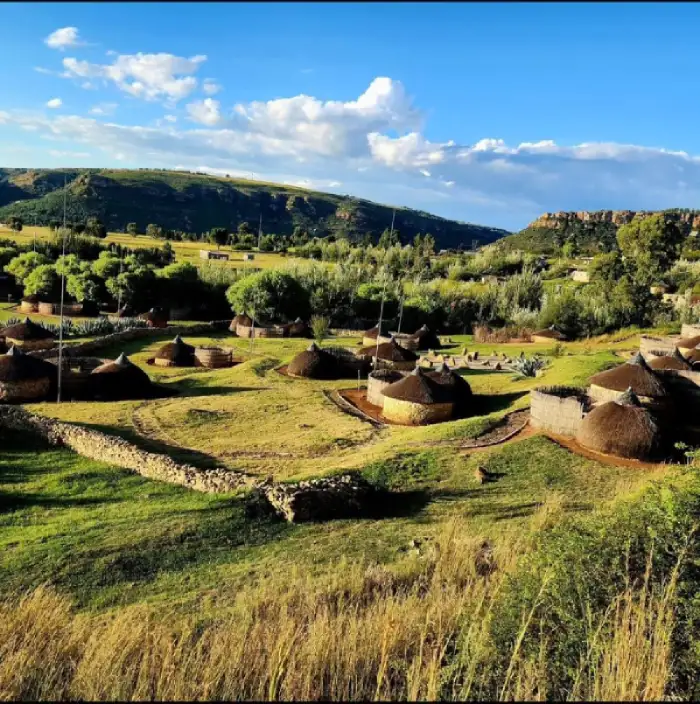
If you’re wondering why Lesotho is called the Kingdom in the Sky, the answer begins with its extraordinary altitude.
Spend some time looking at the country's geography, however, and the nickname begins to make perfect sense.
Lesotho is an exceptionally high-altitude country. Its entire territory lies more than 1,000 metres above sea level, with much of the country rising far higher into the Maloti Mountains.
That elevation influences the landscapes, climate, roads and communities visitors encounter throughout the country.
From mountain passes and waterfalls to highland villages and pony trails, Lesotho's geography is a major part of what makes travelling through the country so memorable.
Why Lesotho Is Called the Kingdom in the Sky
Unlike countries where mountains rise from large areas of low-lying land, Lesotho is elevated throughout its territory.
Its lowest areas are still remarkably high by international standards, while the country's mountain peaks rise above 3,000 metres.
Thabana Ntlenyana, Lesotho's highest point, reaches approximately 3,482 metres above sea level.
This extraordinary elevation is the geographical foundation of the “Kingdom in the Sky” nickname.
It also helps explain why travelling through Lesotho can feel very different from travelling through neighbouring lower-altitude regions.
Visitors encounter landscapes shaped by:
- Mountain ridges
- Deep valleys
- Rivers and waterfalls
- High-altitude grasslands
- Dramatic mountain passes
- Remote settlements
- Expansive views across the highlands
The higher you travel, the more obvious Lesotho's mountain identity becomes.
The Maloti Mountains: Lesotho's Natural Crown
The Maloti Mountains dominate much of Lesotho's landscape and form part of the wider Maloti–Drakensberg mountain system.
For travellers, the mountains aren't simply something to admire from a distance.
Roads climb through them.
Villages sit among them.
Rivers cut through them.
Ponies cross them.
And much of Lesotho's outdoor tourism takes place within them.
Depending on your route, you may encounter deep valleys, grass-covered slopes, waterfalls, mountain streams and dramatic passes.
Some well-known mountain routes and passes include:
- Mafika-Lisiu Pass
- Moteng Pass
- Mahlasela Pass
- Sani Pass
Road conditions, weather and vehicle requirements can vary considerably, so research your particular route before travelling. Our guide to driving in Lesotho covers additional road, vehicle and route-planning considerations.
But when conditions are suitable, simply driving through Lesotho can become one of the highlights of the trip. Travellers looking for road-trip inspiration can also explore our guide to the best scenic drives near Maseru.
Life at High Altitude
The Kingdom in the Sky isn't defined only by mountains.
It is also home to communities that have lived among those mountains for generations.
Travelling through rural Lesotho can introduce visitors to scenes closely associated with Basotho life, including:
- Shepherds tending livestock
- Basotho blankets
- Horses and ponies
- Mountain villages
- Agricultural landscapes
- Traditional and modern homes existing alongside one another
The Basotho pony has a particularly strong association with the highlands, where horses have long provided an effective way of travelling across rugged terrain. Visitors interested in experiencing this part of the country's mountain culture can learn more in our guide to pony trekking in Lesotho.
For visitors, this relationship between landscape and culture is one of the most interesting parts of exploring Lesotho.
The mountains aren't simply scenery surrounding Basotho communities.
They are part of the environment in which generations of Basotho history and daily life have developed.
Why Lesotho's Climate Can Surprise Visitors
Altitude affects temperature, and that can surprise first-time visitors who arrive expecting consistently hot weather simply because they are travelling in Africa.
Lesotho experiences significant seasonal variation.
Summer can bring warm days as well as rain and thunderstorms, while winter can bring very cold mornings and nights. Snow and ice can occur, particularly in higher mountain areas when the right weather systems arrive.
Conditions can also differ significantly between Maseru and higher-altitude destinations.
That means a warm afternoon in the capital doesn't necessarily tell you what conditions will be like later in the mountains.
If your itinerary includes the highlands, check the forecast for your actual destination rather than relying only on Maseru's weather. For broader seasonal planning, see our guide to weather throughout the year in Lesotho.
Lion Guard Travel Tip
Pack layers when exploring Lesotho. Conditions can change with altitude, location and time of day, so a warm layer and appropriate weather protection can be useful even when Maseru feels comfortable.
Places That Show Why Lesotho Is the Kingdom in the Sky
You don't need to understand geography textbooks to appreciate Lesotho's elevation.
Visit some of its natural attractions and the landscape explains itself.
Maletsunyane Falls
Near Semonkong, Maletsunyane Falls plunges approximately 192 metres into a dramatic gorge.
It is one of Lesotho's best-known natural attractions and a striking example of the country's highland landscape.
The surrounding Semonkong area also offers opportunities for walking, pony trekking and other outdoor experiences.
Katse Dam
Katse Dam combines dramatic highland scenery with one of Lesotho's major engineering projects.
The journey into the area takes travellers through mountain terrain that can be just as memorable as the destination itself.
Because Katse is well beyond central Maseru, plan the journey according to current road conditions, weather and the amount of time available rather than treating it as a quick excursion.
Ts'ehlanyane National Park
Ts'ehlanyane National Park offers rugged mountain scenery, hiking opportunities, waterfalls, birdlife and distinctive high-altitude vegetation.
It is one of the destinations where visitors can spend more time experiencing Lesotho's mountain environment on foot rather than simply viewing it from the road.
Bokong Nature Reserve
Bokong Nature Reserve provides another window into Lesotho's high-altitude environment.
The surrounding landscape is characterised by mountain scenery and wide views across the highlands.
Weather can change quickly at elevation, so appropriate clothing and current local information are important when planning a visit.
Morija
For travellers interested in understanding the country beyond its scenery, Morija adds an important historical and cultural dimension.
The area has played a significant role in Lesotho's religious, educational and cultural history.
Check current visitor and opening information for individual museums, archives and attractions before travelling.
More Than Mountain Scenery
Lesotho's landscape creates opportunities for many different types of travel.
Depending on your destination, season, current conditions and available operators, experiences can include:
- Hiking
- Pony trekking
- Mountain biking
- Birdwatching
- Fishing
- Photography
- Camping
- Scenic driving
- Cultural experiences
- Stargazing
Some activities require guides, permits, specialised equipment or advance arrangements, so don't assume every activity can be undertaken independently.
The more remote your plans become, the more important route-specific preparation becomes.
Maseru: Your Starting Point for Exploring Lesotho
Maseru provides a useful starting or finishing point for many Lesotho itineraries.
The capital gives travellers access to shops, restaurants, services and major road connections before they travel farther into the country.
However, Lesotho's mountain attractions are spread across a substantial area.
Some places can fit comfortably into a Maseru-based itinerary, while more distant highland destinations may deserve their own overnight stay.
A good approach is to plan according to the destination rather than assuming every attraction should be visited as a day trip.
Lion Guard Guest House in Ha-Matala provides a practical Maseru base before or after those journeys.
Guests can return to amenities including:
- Free Wi-Fi
- Secure enclosed parking
- Private bathroom
- Reliable hot water
- In-room fridge
- Table and chair
- Daily housekeeping
- Heater during colder weather
- Electric blanket
For road travellers in particular, spending a night in Maseru can provide time to rest, check weather and road conditions, organise supplies and prepare for the next stage of the journey.
The Landscape and the People Belong to the Same Story
One of the most memorable things about travelling through Lesotho is how closely landscape and everyday life remain connected.
Mountain roads pass settlements.
Shepherds move livestock across hillsides.
Horses remain part of rural life.
Basotho blankets are visible in communities throughout the country.
And beyond the major towns, enormous mountain landscapes often dominate the horizon.
Visitors should experience those communities respectfully. Understanding Basotho hospitality and local customs can also help visitors approach these interactions with greater awareness.
Ask before taking close photographs of people, respect private property and remember that rural villages are people's homes rather than tourist displays.
That respect makes cultural travel more meaningful for everyone involved.
Frequently Asked Questions
Why is Lesotho called the Kingdom in the Sky?
The nickname reflects Lesotho's extraordinary elevation. The entire country lies more than 1,000 metres above sea level, while much of its territory consists of substantially higher mountain and plateau landscapes.
What is the highest point in Lesotho?
Thabana Ntlenyana is Lesotho's highest mountain, reaching approximately 3,482 metres above sea level.
Does it snow in Lesotho?
Yes. Snow can occur in Lesotho, particularly in higher mountain areas during colder periods. However, snowfall depends on location and weather conditions and isn't guaranteed throughout winter.
Is Lesotho worth visiting?
Lesotho offers mountain scenery, Basotho culture, historical attractions, scenic road journeys and outdoor activities. Whether it suits a particular traveller depends on their interests, itinerary and preferred type of travel.
When is the best time to visit Lesotho?
There isn't one ideal period for every traveller. Different seasons suit different activities, and conditions vary substantially between Maseru and higher-altitude areas. Check current weather for the specific places on your itinerary before travelling.
Can I explore Lesotho while staying in Maseru?
Maseru can work well as a base for parts of a Lesotho itinerary, particularly attractions within reasonable travelling distance of the capital. More distant highland destinations may be better experienced with an overnight stay closer to the attraction.
Where can I stay in Maseru?
Lion Guard Guest House is located in Ha-Matala, Maseru, approximately 7 km from Maseru CBD. It provides a practical base for travellers who want to spend time in the capital before or after exploring other parts of Lesotho.
Discover the Kingdom in the Sky
Lesotho's nickname becomes easier to understand once you experience the country beyond a map.
It is there in the mountain roads climbing toward the highlands.
It is there in the waterfalls dropping into deep gorges.
It is there in the ponies crossing rugged terrain, villages surrounded by mountains and peaks rising above 3,000 metres.
The landscape has influenced how people travel, live and experience this country.
And that's why “Kingdom in the Sky” is more than a memorable nickname.
It's one of the simplest ways to describe Lesotho.
If you're planning your first journey through these landscapes, our first-time visitor's guide to Lesotho can help you turn that inspiration into a practical itinerary.